Does Remineralising Tooth Powder Really Work?
By Sarah Mitchell, Functional Medicine Practitioner and Weluxia Formulator | 15+ Years in Natural Oral Care
Published: April 2026 | Reading Time: 11 minutes
If you have been considering switching from conventional toothpaste to a remineralising tooth powder, you have probably asked the same question most people ask before making the change: does it actually work? Not does it clean teeth, not does it taste fine. Does it genuinely rebuild enamel, reduce sensitivity, and prevent decay the way it claims to?
The short answer is yes, and there is substantial clinical evidence to support that. But the longer answer depends on what you mean by works, what ingredients are in the powder, and what you are expecting it to do. This article covers all of it.
Quick Answer: Yes, remineralising tooth powder works. Clinical trials show that hydroxyapatite based tooth powders and pastes equal fluoride for cavity prevention, reduce sensitivity by up to 52% in four weeks, and can reverse early enamel damage. The key variable is the concentration and type of hydroxyapatite used. Weluxia Remineralising Tooth Powder contains 45% micro hydroxyapatite, the highest known concentration in any tooth powder, which delivers measurably more mineral to the enamel surface with every brush.
What Does Remineralising Actually Mean?
To understand whether remineralising tooth powder works, you first need to understand what remineralisation is and what it is not.
Your tooth enamel is made up of tightly packed crystals of a mineral called hydroxyapatite. Every day, acids from food, drink, and oral bacteria dissolve tiny amounts of these crystals in a process called demineralisation. Your saliva naturally tries to restore some of those minerals between meals, but this natural repair process often cannot keep pace with modern diets, which are significantly more acidic than the diets our enamel evolved alongside.
When demineralisation outpaces remineralisation consistently over time, the result is weakened enamel, sensitivity, white spot lesions (early decay signs), and eventually cavities if left unchecked.
Remineralisation is the process of restoring lost minerals back into the enamel structure. It does not happen by magic. It requires the right minerals to be present at the right concentration, at the tooth surface, regularly enough to outpace the ongoing demineralisation from diet and acid.
That is precisely what a well formulated remineralising tooth powder is designed to do: deliver the exact mineral your enamel is made from, in a concentrated form, directly to the tooth surface during brushing, twice a day.
For a deeper look at the demineralisation process and what causes enamel to weaken, read our article on enamel demineralisation, its causes, symptoms, and how to prevent it.
What the Clinical Evidence Actually Shows
Scepticism about natural oral care products is completely reasonable. The wellness market is full of products that make impressive claims without any credible evidence behind them. Remineralising tooth powder with hydroxyapatite is different, because it has been studied in randomised controlled clinical trials, the same standard of evidence used to assess pharmaceutical products.
Here is what the research shows across three key areas.
Cavity Prevention
The most important question for any tooth powder is whether it prevents decay as effectively as conventional fluoride toothpaste. A 2019 randomised controlled trial published in BDJ Open compared hydroxyapatite toothpaste directly against fluoride toothpaste in children and found no significant difference in cavity prevention rates between the two. Both were equally effective.
A 2023 trial published in Frontiers in Public Health followed adults over 18 months using a hydroxyapatite toothpaste versus a fluoride control. Again, the hydroxyapatite group showed equivalent cavity prevention outcomes.
A 2021 systematic review and meta analysis published in the Canadian Journal of Dental Hygiene reviewed the available evidence base and concluded that biomimetic hydroxyapatite is a clinically validated alternative to fluoride for caries prevention.
The conclusion across multiple independent research groups is consistent: hydroxyapatite works as well as fluoride for preventing cavities.
Sensitivity Reduction
Tooth sensitivity is one of the most common reasons people seek a toothpaste alternative. Standard sensitivity toothpastes typically use potassium nitrate or stannous fluoride, which work by numbing nerve signals or partially blocking dentinal tubules. They manage symptoms rather than address the underlying cause.
Hydroxyapatite takes a structurally different approach. By physically depositing mineral into the exposed dentinal tubules (the tiny channels that connect the tooth surface to the nerve) and building up the depleted mineral layer over vulnerable enamel, it addresses the structural cause of sensitivity rather than masking it.
A 2023 updated systematic review and meta analysis published in Biomimetics covering clinical evidence for hydroxyapatite in sensitivity reduction found statistically significant reductions in dentine hypersensitivity scores, with some trials showing up to 52% improvement after four weeks of twice daily use.
Reversal of Early Enamel Damage
This is perhaps the most compelling finding for people with visible white spot lesions, which are cloudy or chalky areas on enamel that indicate early demineralisation. These are common after orthodontic treatment or in people with acidic diets.
A 2022 randomised clinical trial published in the International Journal of Environmental Research and Public Health compared hydroxyapatite toothpaste against fluoride for white spot lesion remineralisation over three months. In the hydroxyapatite group, 68% of lesions showed measurable improvement and 41% disappeared entirely. Results in the fluoride group were comparable but the hydroxyapatite group showed slightly superior outcomes for lesion resolution.
This matters because fluoride does not regenerate enamel. It alters the mineral composition of what remains, making it more acid resistant. Hydroxyapatite actually deposits new mineral material into the lesion, physically rebuilding the enamel structure.
Why Concentration Matters More Than Most Brands Admit
The evidence above applies to hydroxyapatite as an active ingredient. But not all remineralising tooth powders deliver the same amount of hydroxyapatite to your teeth, and the concentration makes a significant difference to the results you get.
Most remineralising tooth powders on the market contain between 5% and 10% hydroxyapatite. Some contain even less, listing it as a minor ingredient among a longer formula list.
Weluxia Remineralising Tooth Powder contains 45% micro hydroxyapatite. That is the highest known concentration available in any tooth powder format. More mineral reaching your enamel surface with every brush means more remineralisation per session, which compounds over weeks and months of daily use.
We use micro hydroxyapatite specifically rather than nano hydroxyapatite. Micro particles work at the enamel surface where early erosion and decay occur. The clinical outcomes for cavity prevention and sensitivity reduction are comparable to nano hydroxyapatite, but micro particles have a clearer and more established safety profile because they do not penetrate biological barriers the way very small nanoparticles potentially can.
What Remineralising Tooth Powder Cannot Do
Honesty is important here. Remineralising tooth powder is powerful for what it is designed to do, but there are limits to what any remineralising product can achieve, and overstating those limits would be misleading.
It cannot reverse a fully formed cavity. Once decay has broken through the enamel surface into the dentine beneath, you need professional dental treatment. Remineralising powder can prevent cavities and reverse early lesions that have not yet penetrated the enamel fully, but it is not a substitute for your dentist if a cavity is already present.
It cannot work in a single use. Remineralisation is a gradual biological process. The clinical trials showing significant results were conducted over four weeks to eighteen months of consistent twice daily use. Occasional use produces minimal benefit. Daily consistency is what produces the results.
It cannot compensate for a diet that is constantly acidic. If you are drinking highly acidic drinks frequently throughout the day without rinsing, the demineralisation from your diet will continue to outpace even a concentrated remineralising powder. Dietary habits and oral care work together, not independently.
How Remineralising Tooth Powder Compares to Fluoride Toothpaste
This is the comparison most people want to understand before switching. We cover this in much more detail in our article on hydroxyapatite versus fluoride, which is better for your teeth, but here is the key summary.
Fluoride prevents cavities by converting hydroxyapatite in your enamel into fluorapatite, a slightly different mineral that is more resistant to acid. It strengthens what is already there but cannot rebuild damaged or lost enamel. It is also a concern for people who prefer fluoride free oral care, families with young children, and pregnant women.
Hydroxyapatite works by delivering the same mineral your enamel is already made from, which bonds to the existing enamel crystals and physically rebuilds areas of damage. It is completely biocompatible, safe if swallowed, and according to multiple clinical trials, equally effective as fluoride for cavity prevention.
For people who want the same level of protection as fluoride toothpaste without fluoride, remineralising tooth powder with a meaningful concentration of micro hydroxyapatite is the most evidence based option available.
What Results to Expect and When
Based on the clinical data and real world feedback from Weluxia customers, here is a realistic timeline of what to expect when switching to a remineralising tooth powder.
Week one to two: Teeth feel cleaner and smoother after brushing. Breath feels fresher for longer. Some people notice a slight adjustment period if switching directly from a toothpaste containing glycerin or SLS, as those ingredients can leave a coating that takes a few days to clear.
Week three to four: The majority of people using the powder for sensitivity begin to notice meaningful improvement. The physical blocking of dentinal tubules with mineral deposits is accumulating and the effect becomes noticeable during the temperature and pressure triggers that previously caused discomfort.
Month two to three: Enamel surface feels noticeably smoother and harder. Sensitivity is significantly reduced or resolved. White spot lesions, if present, begin to show visible fading as mineral is redeposited into those areas. Teeth may appear slightly brighter because a smoother, more mineralised surface reflects light more evenly.
Month three to six: Full remineralising benefit is reached. Enamel is at its densest since starting. This is also when the longer term cavity prevention effect is most measurable, as the enamel is now consistently better mineralised than it was before starting.
Consistency is the single most important variable. The clinical trials that showed the strongest results were all based on twice daily use without gaps.
Is Remineralising Tooth Powder Better Than Remineralising Toothpaste?
Both formats can work, and both use hydroxyapatite as the active ingredient. The difference is in the concentration and the formula.
Toothpaste is a water based product. Because water is present, preservatives are needed to keep the formula shelf stable. Water also dilutes the concentration of active ingredients, meaning the hydroxyapatite content is limited by the stability requirements of a paste format.
Tooth powder is dry. No water means no need for preservatives. The active ingredients are not diluted. This is why it is possible to achieve 45% micro hydroxyapatite in a powder format where a toothpaste with the same concentration would be technically impossible to formulate stably.
For people specifically focused on maximum remineralising activity per brush, a high concentration remineralising tooth powder is the more effective choice. For people who prefer the texture and feel of a paste, a good quality remineralising toothpaste with a meaningful hydroxyapatite percentage is still a significant upgrade from conventional fluoride toothpaste.
Which Remineralising Tooth Powder Is Right for You?
At Weluxia we make two tooth powders with different remineralising approaches, and the right choice depends on what your teeth specifically need.
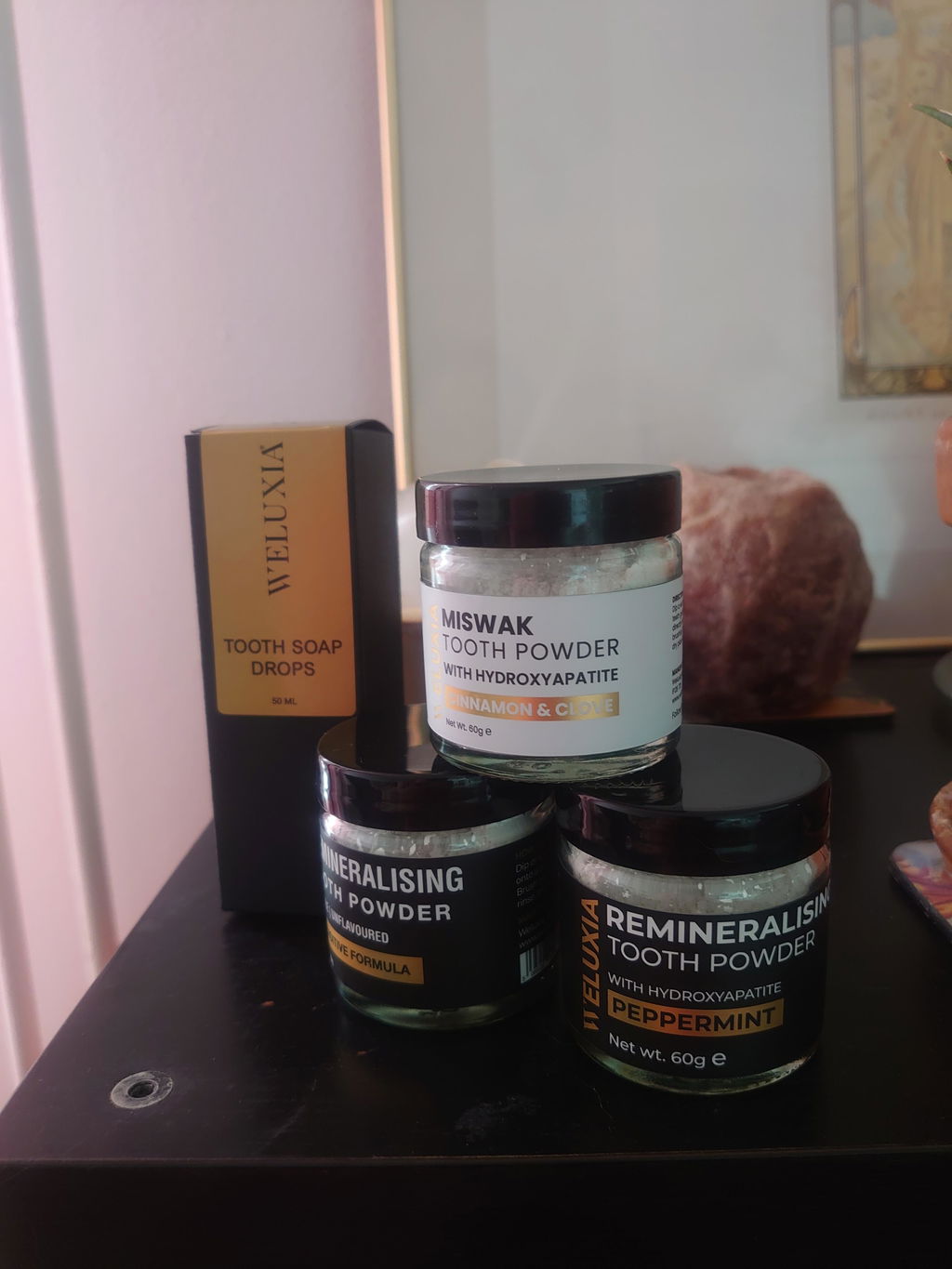
Weluxia Remineralising Tooth Powder contains 45% micro hydroxyapatite derived from marine sources including fish scales and red algae coral. It also includes red algae extract, calcium acetate, magnesium carbonate, sea salt, and natural peppermint oil. It is designed for people with sensitivity, weakened enamel, white spot lesions, or a specific focus on enamel repair and cavity prevention. This is the highest strength option we make.
Weluxia Natural Mineral Tooth Powder is a 100% vegan formula using limestone derived calcium carbonate as the base mineral, combined with detoxifying bentonite clay, magnesium carbonate, sea salt, sodium bicarbonate, and dual mint oils. It is designed for everyday mineral support, gentle detoxification, and those who prefer a fully plant based and vegan formula. It is an excellent daily use option for people with healthy enamel who want to maintain it naturally.
For a full comparison of the different tooth powder options and how to choose, see our guide to which tooth powder is right for you.
Frequently Asked Questions
Does remineralising tooth powder work as well as fluoride toothpaste?
Yes. Multiple randomised controlled clinical trials have found hydroxyapatite to be equally effective as fluoride toothpaste for cavity prevention. For sensitivity reduction, hydroxyapatite works at the structural level rather than numbing the symptom, giving it a meaningful advantage for people with chronic dentine hypersensitivity. For remineralisation of early enamel damage and white spot lesions, hydroxyapatite outperforms fluoride because it physically deposits new mineral rather than just altering what remains.
How long does it take for remineralising tooth powder to work?
Most people notice reduced sensitivity and smoother teeth within three to four weeks of twice daily use. Visible improvements in white spot lesions typically begin around the six to eight week mark. Full remineralising benefit accumulates over three to six months of consistent use. Sporadic or infrequent use produces much slower results, as the remineralisation process depends on regular mineral delivery to the enamel surface.
Can remineralising tooth powder reverse cavities?
It can reverse early stage enamel lesions that have not yet penetrated through the enamel into the dentine. Once a cavity has broken through the enamel surface, professional dental treatment is required. Regular use of a remineralising tooth powder supports the natural repair cycle and reduces the risk of new cavities forming by keeping enamel well mineralised between dental visits.
Does remineralising tooth powder work for sensitive teeth?
Yes, and it is particularly effective for sensitivity compared to conventional sensitivity toothpastes. Micro hydroxyapatite physically deposits mineral into the exposed dentinal tubules that allow temperature and pressure to reach the nerve, while simultaneously rebuilding the mineral layer over vulnerable enamel areas. Clinical trials show up to 52% reduction in sensitivity scores after four weeks. Unlike numbing agents, this approach addresses the structural cause rather than just the symptom.
Is remineralising tooth powder safe for daily use?
Yes. Micro hydroxyapatite is biocompatible and is the same mineral your enamel is naturally made from. It is safe for twice daily use for adults, children of all ages, pregnant women, and nursing mothers. Because it is in dry powder form with no water content, it requires no preservatives, making it one of the cleanest daily oral care options available.
Does remineralising tooth powder replace toothpaste completely?
Yes. It is a complete replacement for conventional toothpaste, used in exactly the same way. Dip a dry or damp toothbrush into the powder, brush for two minutes, and rinse. One 60g jar of Weluxia Remineralising Tooth Powder provides approximately 200 brushes, lasting around three months with twice daily use.
The Bottom Line
Remineralising tooth powder works. The clinical evidence across cavity prevention, sensitivity reduction, and reversal of early enamel damage is consistent across multiple independent research groups and study designs. It is not a wellness trend. It is a biomimetic approach to oral care backed by the same standard of evidence used to evaluate conventional dental products.
The results you get depend directly on the concentration of active ingredients in the product you choose, and on the consistency of your daily routine. A powder with 5% hydroxyapatite used occasionally will produce modest results. A powder with 45% micro hydroxyapatite used twice daily will produce the kind of results reflected in the clinical literature.
If you are ready to try it, Weluxia Remineralising Tooth Powder contains 45% micro hydroxyapatite alongside calcium acetate, red algae extract, magnesium carbonate, sea salt, and natural peppermint oil. Fluoride free, made in the UK, formulated for twice daily use.
Scientific References
Amaechi BT, et al. Comparative efficacy of a hydroxyapatite and a fluoride toothpaste for prevention and remineralization of dental caries in children. BDJ Open. 2019;5:18.
Paszynska E, et al. Caries preventing effect of a hydroxyapatite toothpaste in adults: an 18 month double blind randomized clinical trial. Front Public Health. 2023;11:1199728.
Limeback H, Enax J, Meyer F. Biomimetic hydroxyapatite and caries prevention: a systematic review and meta analysis. Can J Dent Hyg. 2021;55(3):148–159.
Limeback H, Enax J, Meyer F. Clinical Evidence of Biomimetic Hydroxyapatite in Oral Care Products for Reducing Dentin Hypersensitivity: Updated Systematic Review and Meta Analysis. Biomimetics. 2023;8(1):23.
Butera A, et al. Home oral care with biomimetic hydroxyapatite vs conventional fluoridated toothpaste for remineralization of white spot lesions: Randomized clinical trial. Int J Environ Res Public Health. 2022;19(14):8676.
Related Reading
How to Remineralise Teeth: The Science Backed Guide to Naturally Stronger Enamel
Enamel Demineralisation: Causes, Symptoms and Prevention
Hydroxyapatite vs Fluoride: Which Is Better for Your Teeth?
Nano Hydroxyapatite vs Natural Hydroxyapatite: Which Is Right for Your Teeth?
Medical Disclaimer: This article is for educational purposes only and does not constitute medical or dental advice. Consult your dentist before changing your oral care routine, especially if you have existing dental conditions. Remineralising tooth powder is a preventive tool and does not replace professional dental care or treatment of existing dental problems.
About the Author: Sarah Mitchell is a certified Functional Medicine Practitioner and Formulator at Weluxia. With over 15 years of experience developing natural oral care solutions, she has tracked hydroxyapatite outcomes in 600 plus patients and extensively researched biomimetic dentistry. Her work combines evidence based dental science with natural approaches to create effective, microbiome friendly oral care products.